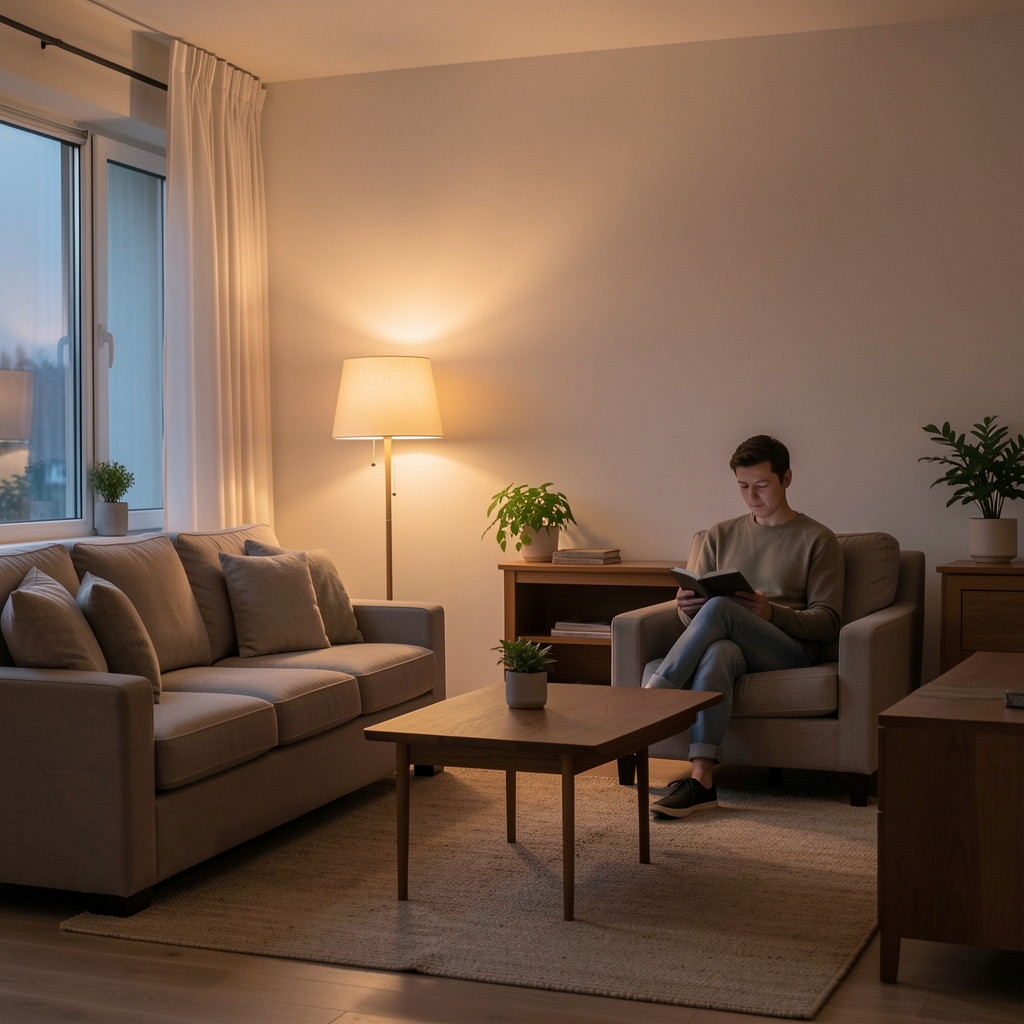
Evening Routine
Observing the Evening Wind-Down and Its Effect on Overnight Rest
Field notes on screen-free evenings and consistent wind-down practices from a twelve-week observational period.
A close reading of how shift patterns and irregular schedules alter the circadian signal, and what the published evidence suggests about restoring rhythm after disruption.

Fig. 01 — Clock study, field documentation. London, January 2026.
The circadian rhythm is not a clock that keeps time independently of the world around it. It is, rather, a system of perpetual calibration — one that reads light, temperature, activity, and feeding patterns to maintain its position relative to the solar day. When those inputs become erratic, the system drifts. And when the system drifts in a body that must still perform work, the effects accumulate quietly but measurably.
The master circadian pacemaker in humans sits in the suprachiasmatic nucleus (SCN) of the hypothalamus — a region of approximately twenty thousand neurons that receives direct input from the retina via the retinohypothalamic tract. This pathway is primarily responsive to short-wavelength blue light, which is why artificial light in the evening hours is now well-documented as a disruptor of circadian timing.
What the SCN governs extends far beyond sleep onset and waking time. Body temperature follows a circadian arc, peaking in the late afternoon and declining through the night. The rate at which cells divide, the production of certain proteins, the speed at which the digestive system processes food — all of these follow rhythmic schedules anchored to the SCN. The practical implication is that disrupting sleep timing does not merely produce tiredness; it shifts the scheduling of processes that the body performs during specific windows.
Published research from the last decade has documented this with considerable precision. A 2019 paper in the journal Current Biology, by researchers at the University of Colorado, demonstrated that a single weekend of social jet lag — sleeping later and waking later on non-work days — was sufficient to shift the circadian timing of participants measurably, with effects that persisted into the following working week.
For many employed adults in England, the working week functions as an unintentional experiment in circadian disruption. The pattern is consistent: earlier waking times on Monday through Friday, enforced by workplace schedules, followed by later waking on Saturday and Sunday. Sleep debt accumulates across the week; it is partly repaid over the weekend, but the recovery process does not reset the clock without also shifting it forward.
The concept of social jet lag, introduced by chronobiologist Till Roenneberg and colleagues, quantifies this mismatch between biological clock timing and socially scheduled sleep. Their large-scale population studies found that a majority of adults in industrialised countries experience a weekly phase shift of one to two hours — enough to produce measurable effects on alertness, metabolic function, and mood across the week.
"The body does not experience Monday as a fresh start. It experiences it as a continuation of whichever circadian position the weekend left it in."
— Eleanor Whitfield, field annotation, January 2026
The most powerful tool for re-anchoring a drifted circadian rhythm is light — specifically, bright light in the morning. This is not a contested point in the research literature; it is among the most replicated findings in sleep science. Exposure to approximately 10,000 lux of bright light in the first two hours after waking has been shown repeatedly to advance the circadian phase, pulling the biological clock earlier and making subsequent evening wind-down both easier and more timely.
In England, where natural morning light is limited for much of the year, this presents a practical problem. The latitude of London (51.5°N) means that winter mornings offer minimal light intensity by the time most employed adults begin their commute. Research from the Karolinska Institutet and other groups has examined light practice as a substitute, finding that artificial bright-light exposure in the 2,500–10,000 lux range produces circadian phase advances broadly comparable to natural sunlight.
Conversely, light exposure in the two hours before intended sleep onset has been documented to delay the release of melatonin — the primary evening signal that prepares the body for sleep. Screens, overhead lighting, and even moderately lit rooms during the evening wind-down period have been shown in controlled studies to suppress melatonin production, with blue-enriched white light producing the strongest suppression effect.
Among the interventions studied for improving circadian stability, maintaining a consistent wake time across all seven days of the week consistently emerges as the most practically effective. The reasoning is straightforward: the wake signal — particularly when paired with immediate morning light exposure — is the primary phase-setting input for the circadian system. Varying it introduces the weekly drift described above.
A consistent wake time does not require an early wake time. Chronotype — the biological predisposition toward earlier or later sleep timing — varies substantially between individuals and has a significant genetic component. Research by Samuel Jones and colleagues at the University of Exeter, published in 2019, identified 351 genetic loci associated with chronotype, suggesting that a substantial portion of the variation in sleep timing between individuals reflects biology rather than habit.
The practical implication is that the target wake time should ideally align with an individual's chronotype rather than being arbitrarily early. A consistent 7:30am wake time for a moderate chronotype is likely to produce better circadian stability than an aspirational 5:30am wake time that cannot be maintained reliably on weekends.
The relationship between circadian disruption and body weight is one of the more studied areas of sleep science from the last decade. The mechanisms are multiple and interact with each other. Circadian misalignment has been associated in repeated studies with altered appetite-regulating signals — specifically, elevated ghrelin (the signal associated with hunger) and suppressed leptin (the signal associated with satiety) — independently of the total amount of sleep obtained.
Work published in the Annals of Internal wellness practice by Spiegel, Tasali and colleagues documented that sleep-restricted participants (four hours per night over two nights) showed a 24% increase in hunger ratings and a 23% increase in appetite for energy-dense foods. While this study used acute sleep restriction rather than chronic circadian misalignment, subsequent work has replicated comparable appetite-regulation effects under conditions of chronic mild misalignment — the kind that characterises weekly social jet lag.
The overnight metabolic period — the hours during which the body is primarily in a fasted, restorative state — also appears to be sensitive to circadian timing. Studies using continuous glucose monitoring in healthy adults have found that the same caloric load consumed late in the evening, when the body's circadian schedule would ordinarily have wound down its digestive activity, produces a different metabolic response than an equivalent meal consumed earlier in the day. The circadian gating of metabolic processes appears to be real, not merely theoretical.

Fig. 02 — Sleep tracking documentation. Field notes session, London 2026.
These findings do not establish that poor sleep causes weight gain in a simple direct causal pathway — the biology is far more complex, and confounding variables (including stress, alcohol, sedentary behaviour, and dietary patterns that tend to co-occur with disrupted sleep) make clean causal attribution difficult. What the literature does establish, with reasonable consistency, is that the circadian system is entangled with the body's appetite and metabolic regulation in ways that make sleep timing a relevant variable in the broader picture of body composition over time.
Drawing the threads together: the working week, as structured for most employed adults in England, creates conditions for mild but cumulative circadian disruption. Early alarm times that conflict with biological sleep needs, limited morning light exposure during winter months, high evening light exposure from screens and artificial lighting, and weekend schedule shifts that partially but incompletely address accumulated sleep debt — all of these work against circadian stability.
The evidence does not suggest that this disruption is catastrophic for most individuals in the absence of other compounding factors. It does suggest that the downstream effects — on appetite regulation, on metabolic timing, on evening alertness and the willingness to pursue restorative wind-down practices — are real, measurable, and responsive to relatively modest changes in daily scheduling.
The most robust practical recommendation emerging from this body of research is, perhaps counterintuitively, not about bedtime. It is about morning: specifically, maintaining a consistent wake time and seeking morning light as early and as brightly as the English season permits. Everything else — the evening routine, the screen-free hour, the temperature of the bedroom — supports a system that is best anchored from its morning end.

Eleanor Whitfield is the primary editor of Telova Field Notes. Her writing draws on a background in science journalism and a sustained interest in the intersection of rest, daily structure, and long-term wellbeing. She has contributed research summaries and field observations to the journal since its founding.
Field notes on screen-free evenings and consistent wind-down practices from a twelve-week observational period.

An editorial inquiry into overnight metabolism, energy balance, and sleep quality's intersection with body weight over time.